Showing posts sorted by date for query booklet. Sort by relevance Show all posts

Banana Economics, or How to Peel a Banana


As commercial printing became more affordable and widespread in the late 19th century, food companies in the United States increasingly published promotional material designed to educate the consumer about new foods, production and preparation methods, and brands.  With commodities such as milk and fruit, these booklets were often published by a central source that represented a number of smaller companies, thereby linking up regional distribution centers and presenting a uniform image of the product that could be disseminated across the country.  Such booklets assumed limited knowledge on the part of the consumer and provided basic information such as how to determine a fruit's ripeness, as well as scientific attestations to health benefits.


Booklets were typically authored by women affiliated with the company's home economics department.  In the vein of ladies' domestic manuals of the 19th century, these booklets transmitted ideas about the science of nutrition (presented as a male domain) to an assumed female consumer charged with preparing family meals.  A Study of the Banana: Its Everyday Use and Food Value (1942, 5th ed.) is one such example, produced by the Home Economics Department of the Fruit Dispatch Company, Distributors of United Fruit Company.  Although no single author's name is given, a first edition copy of the same title is credited to Ina S. Lindman, who was director of United Fruit Company's home economics department until the 1950s.


It can be interesting to contrast the information presented in such booklets with current renderings of the same food item.  For instance, if one compares the nutritional facts stated in the booklet with the current data listed on the USDA's and the Chiquita Banana website, it appears that today's vitamin and mineral levels are significantly lower.  Perhaps the data are computed differently today, but if the numbers published in 1942 are correct, then for every 100g of raw banana, there has been a decrease in iron (about half), magnesium (4 mg), phosphorous (4 mg), and potassium (15 mg).  Oddly the booklet lists 42.0 mg of sodium, which is grossly out of proportion with today's 1.0 mg, suggesting a misprint.  I wonder if the other editions show the same figure.


In branding a Latin American food crop under one North American corporate entity, United Fruit Company exerted an imperialist influence with political, environmental, and social repercussions.  Through material such as booklets, food corporations tacitly reinforced a distinction between those who produce and those who consume.  Here, it is clear that the booklet speaks to white American consumers of all ages, as illustrated in the photographs below.
  

This 1942 edition is illustrated with a jolly though rather generic anthropomorphic banana.  Two years later the United Fruit Company adopted the feminized Chiquita banana logo, based on the entertainer, Carmen Miranda, further commodifying indigenous culture and entrenching notions of exoticism.


Blancmange: Affordable Elegance


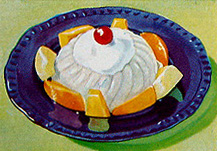
As promised in my post on the Cream Top Milk Separator, I've tested one of the recipes from the Cream Top booklet-- Vanilla Cornstarch Pudding. Also known as blancmange, this classic white dessert came to be known as vanilla pudding in the United States by the 1930s. The lovely and elegant blancmange was perfectly suited to the Depression era recipes of the Cream Top booklet and its pledge of "luxury without extravagance", as the only ingredients are milk, a small amount of sugar and salt, and cornstarch.  Instead of using cow's milk, I made the recipe with coconut milk. You could also try rice or almond milk, from which blancmange has long been prepared, or any other nut milk.  The cornstarch is used for firming and works wonderfully, without adulterating the taste of the pudding.  Although I haven't tried it, I'm sure arrowroot powder would work just as well.  Gelatin is often used in blancmange to create a densely moulded shape but I prefer the soft buoyancy yielded from cornstarch.  For a stiff mould, try using agar-agar instead of gelatin.  Blancmange is a very simple dessert and one of the most satisfying things to eat on a warm day because of its cold, slippery texture.  The taste is light and subtle, much like rice pudding without the rice, and therefore the perfect template on which to experiment, by adding flavors such as rosewater, saffron, and cardamom, or embedding ingredients such as edible flowers in the mould.


Recipe
Vanilla Cornstarch Pudding
, adapted from the Cream Top Recipe Booklet

Ingredients

3 Tbs cornstarch
3 cups coconut or almond milk (original recipe uses cow's milk)
4 Tbs granulated sugar
1/2 tsp vanilla extract
1/4 tsp salt
1/2 cup heavy cream, whipped (I omitted this)


Mix cornstarch, salt, sugar and 1/2 cup of the milk.  Meanwhile scald rest of milk in double boiler.  Pour little of scalded milk on the cornstarch mixture and blend.  Add this to remaining scalded milk and stir constantly until pudding thickens.  Remove spoon, cover double boiler and cook 25 minutes stirring occasionally.  Add vanilla, beat up well, pour into 6 cold wet molds, chill thoroughly, and then unmold.  Serve with whipped cream.  Add sliced fresh fruit, canned fruit or stewed dried fruit, if desired.  Serves 6.

To prevent skin forming on surface of pudding while chilling, cover top of glasses or molds with wax or parchment paper, transparent cellulose sheeting or aluminum foil.

The Cream Top Milk Separator


The Cream Top separator, a humble metal ladle, was designed for the purpose of separating cream from milk in a particular type of milk bottle. Before homogenized milk became widespread in the late 1940s, milk bottles typically featured a top layer of cream-- the fat that naturally rises to the milk's surface.  Cream Top bottles featured a bulge at the cream line where the ladle could rest.  The end of the ladle doubled as a bottle opener and hooked on to the bottle's rim, allowing one to tip over the bottle and pour out the cream using only one hand.

"Something More Than Just a Bottle of Milk"

During the first half of the 20th century in the United States, milk industry practices and the consumption of milk became increasingly standardized by the federal government.  After a century of  milk contamination scandals, measures such as the requirement of pasteurization and the institution of federal milk programs in schools sought to instill public trust in milk as a safe, nutritious food and thus increase consumption of domestic commodities. In early 20th century advertisements, milk is consistently billed as a pure, simple source of nutrition, yet each manufacturer emphasizes a quality that makes theirs different.  See my posts on Selling Milk Between the Wars, Parts I and II. With the Cream Top Corporation, it was the efficiency of their specially designed bottle and the quality of the cream ("so thick it whips instantly"), targeting 1930s housewives in charge of family meal planning.


Cream Top Advertisement, Good Housekeeping, March 1, 1940.
Photo: Gallery of Graphic Design. gogd.tjs-labs.com

Cream Top Advertisement, Good Housekeeping, March 1, 1940.
Photo: Gallery of Graphic Design. gogd.tjs-labs.com

Cream Top Advertisement, Good Housekeeping, June 1, 1935.
Photo: Gallery of Graphic Design. gogd.tjs-labs.com
"Luxury Without Extravagance"
During the Great Depression, Cream Top advertised the idea of cream as an economical luxury.  The recipe booklet below encourages home cooks to use cream in every meal, thereby adding an element of luxury to even the sparest of ingredients: "[cream] adds interest and flavor to soups, salads and even meat courses.  It often transforms left-overs into royal dishes as if by magic...yet it's so simple to use.  Without fuss or bother, you can quickly 'make' whipped cream."  As milk bottles were gradually replaced with paper cartons in the 1940s, the Cream Top bottle faded away.

Like the advertisements above, this 24-page booklet is associated with the magazine, Good Housekeeping.
Here, the recipes have been "tested, tasted and approved by the Good Housekeeping Institute.  Booklet circa 1930s
{Click to enlarge}

{Click to enlarge}

{Click to enlarge}

{Click to enlarge}

Click here for a recipe from the booklet.

More on milk from the archives:
PET Milk and the Business of Feeding Babies
Selling Milk Between the Wars, Parts I and II

Selling Milk Between the Wars: Two Pre-WWII U.S. Milk Industry Booklets
Part II

Borden-Wieland. 1937. "Delicious Dairy Dishes," presented by Crowley's Milk Company, Inc. (promotional booklet). Meta Given and Ruth Cooper (contribs.) 62pp. Illustrated in color.

The Crowley Dairy Company was founded in Poughkeepsie, NY in 1904 by J.K. Crowley. In 1915 the company moved to Binghamton where its headquarters remain today. Because "Delicious Dairy Dishes" (hereafter DDD) is copyrighted by Borden-Wieland and 'presented' by Crowley, I suspect this may have served as a general dairy industry booklet that individual, regional brands could co-opt for marketing purposes.

Over twenty years after "The Story of Carnation Milk" was published, science continued to offer a useful language for marketing consumer goods. In comparing the two milk industry booklets we see that in both cases the recipes are devised to encourage home cooks to use milk in everyday cooking. While the Carnation booklet attempts to convince those who may already be loyal milk consumers that canned milk is a superior, technologically sophisticated alternative, the authoritative tone of the Crowley milk booklet highlights scientific proof of the important vitamins and minerals found in "fresh" dairy foods.

Unlike Carnation's evocative pastoral scene, the cover of DDD features no landscape, just the fruits of industry, prepared according to the tenets of the modern kitchen. The title page reads, "Recipes tested and approved by Meta Given and Ruth Cooper, Specialists in Home Economics." In addition to recipes, the text includes several essays by the authors. Whereas Carnation describes its milk production processes as being supervised by "careful, experienced men", in DDD the focus has shifted to the kitchen, organized according to the philosophy of home economics, a term that gained currency in the early 20th century and was widely used by the booklet's 1937 copyright date.


The introduction page appeals to the health and economic concerns of people during the Depression years, stating,"Milk is the original food and nearly as perfect as you will find. It does more for the body than any other food and does it more cheaply. There is no substitute for milk." The introduction boldly asserts that, "Nutritionists advise that one-fourth of the food budget be spent on milk and its related products. With milk furnishing so much for so little outlay of money, this advice must be sound. So for good health and a long, happy life, use milk and dairy products abundantly."

Milk's beneficial components are then dissected and explained:

All model diets give milk a very important place because: Its
1. Protein is ideally adapted for body growth and repair
2. Sugar (lactose) is helpful in preventing digestive disturbances
3. Minerals (calcium and phosphorous) are easily absorbed and ideal for bone and teeth building.
4. Vitamins (A, B, and G) make this an important source with some trace of vitamins C and D.


As also seen in the PET Milk pamphlet, the emphasis on vitamin content reflects early 20th century health concerns, such as mineral and vitamin deficiencies. The scientific discovery of vitamins in the first quarter of the 20th century and eventual synthesization of vitamins, beginning with vitamin C in 1935, helped remedy nutrition deficiency illnesses such as rickets.

Essays on "The Daily Diet," "Butter Cookery," and "Hints on Vegetable Cookery" further explain the nutritional importance of dairy foods. While butter came to be characterized as unhealthy in the late 1960s due to saturated fat content, DDD champions its healthiness: "A food so high in vitamin A content is valuable in the protection against eye trouble known as Xerophthalmia and against diseases of the upper respiratory organs...Where foods of high caloric content must be cut out, butter should never be on this list, because of its vitamin content."

Despite their slightly different agendas, both milk industry booklets combine recipes for popular dishes with information about the production methods or nutritional content of the product and are designed for home cooks. The latterly published DDD shows several additions and alterations in recipe conventions. A section on hors d'oevres suggests an increased interest in entertaining guests, and the use of regional and international location names in recipe titles, such as Southern Corn Pudding, Coffee Bavarian, and Mexican Orange Candy, may have appealed to a desire for urbanity and an air of cosmopolitan sophistication in the Depression era. Despite being published during an economic crisis, DDD eludes the use of tinned ingredients and items such as lentils, highlighted in the Carnation booklet as "economical."

Promotional recipe booklets are interesting artifacts; while they cannot be depended on to accurately reflect the tastes of the period (unlike cookbooks they lack a measurable value) recipe booklets do portray what companies thought consumers would respond to. Because taste and consumption habits shape and are shaped by such advertising material, these historical documents deserve close reading.


Recipe: Carnation Milk Bread


The Story of Carnation Milk, Booklet, 1915. Things Made with Carnation Milk .

As mentioned in the last post on a 1915 Carnation Milk booklet, the recipes included are adaptations of conventional contemporary favorites such as Perfection Salad, Welsh Rarebit, and Macaroni and Cheese. The bread recipe below includes detailed instruction but omits information about oven temperature and baking time, suggesting that such information would have been understood. The adapted version produces only one loaf and omits the boiling water, using the milk as the only liquid. The resulting loaf is very soft and tasty- delicious plain or toasted, with butter and rhubarb jam.

Carnation Milk Bread, from "The Story of Carnation Milk"
Makes 3 small loaves and a dozen small rolls

1 cup Carnation Milk
2 Tbs shortening
1 Tbs sugar
2 tsp salt
3 cups boiling water
1 yeast cake
1/2 cup lukewarm water
11 to 12 cups (even) flour

Measure Carnation Milk, shortening, sugar, and salt into bowl; pour on the boiling water; stand until lukewarm.
Add the yeast which has been dissolved in the lukewarm water; stir in as much flour as dough will take up, and turn upon bread board.
Knead 15 to 25 minutes, adding additional flour as needed. Put in mixing bowl and cover; set to rise; when risen to double original size, turn on floured board, cut into loaves, kneading only to give shape. Let rise in pans to double size and bake.


5 o'clock teaspoon Adapted Milk Bread
Makes 1 standard loaf

1 cup evaporated milk, plus more for brushing
1 tsp yeast
2 tsp sugar
1 Tbs butter
1/2 tsp salt
2 1/2 to 3 cups all purpose flour

Grease a standard-size metal loaf pan and line with parchment, leaving a 1"-2" border. Pour 1/4 cup warm (almost hot) water in a large, non-reactive bowl and sprinkle yeast over surface of the water. Give it a little swirl so that the yeast dissolves. Gently heat evaporated milk and butter in a saucepan until lukewarm and the butter has dissolved. Pour into bowl, and stir in sugar, salt and 2 cups of flour. Continue to add flour about 1/2 cup at a time until the dough will not take more. Turn on a floured surface and knead 5-7 minutes, adding flour as necessary, until the dough is smooth, soft, and no longer sticky. Place in a large bowl covered by a damp cloth and set in a warm spot until doubled in size, about 1 1/2 hours.
Once dough has risen, gently form into a loaf shape, place in greased loaf tin, cover, and set to rise, about 1 hour. Preheat oven to 375°F. Once loaf has more or less doubled, brush with a little evaporated milk or butter and place in center of oven. Bake for about 30 minutes, or until top is golden brown.
*To be sure the bread is done, lift from pan by pulling on the parchment border. Insert a bamboo grilling skewer through the middle at an inconspicuous spot. If it comes out clean, the loaf is ready.


A reader submitted the following wonderful adaptation of the recipe for use with bread machines:

Carnation Milk Bread Adapted For Bread Machines
Prep Time: 15 | Cook Time: 3 hours | Servings: 1 1-1/2 pound loaf | Difficulty: Easy

Ingredients:

3/8 cup warm water
2 1/4 tsp yeast (1 package)
1 1/2 cup evaporated milk (1 can)
1 1/2 Tbs butter
3 tsp sugar
3/4 tsp salt
3 3/4 cups all purpose flour

Directions:

Sprinkle yeast on top of warm water and then swirl
Heat milk to 100° (30 seconds in microwave, then stir)
Stir in sugar, salt, yeast mixture
Pour into bread machine
Measure flour into bread machine
Set machine to light crust setting if it has one

Notes: Warm means 98°–105°


See also, Selling Milk Between the Wars" Two Pre-WWII U.S. Milk Industry Booklets, Part 1

Selling Milk Between the Wars: Two Pre-WWII U.S. Milk Industry Booklets
Part I


Carnation Milk


Pacific Coast Condensed Milk Company. 1915. "The Story of Carnation Milk" (promotional booklet). 32pp. Illustrated, with some color illustrations. Printed by the American Lithographic Co., NY.

Although first available in the mid-19th century, it took almost a century before canned milk became a trusted product. Booklets such as this one, published in 1915 by Carnation Milk, attempted to gain the public's interest and trust by offering scientific evidence in support of the product and providing favorite recipes adapted to work with evaporated milk. Printed just two years before the inauguration of the American Dairy Science Association, this booklet represents a moment when commodities such as milk became part of an agro-industry structure with a much larger distribution facilitated by improvements to the nation's infrastructure. Elbridge Amos Stuart launched the Carnation brand with a sterilized cream product in 1899. Using a controlled source of milk from the cows on his Seattle dairy farm, Stuart developed the slogan "Carnation Milk, From Contented Cows," creating an image that combines modern, exacting production methods with time-tested knowledge.

The booklet's cover shows a young woman and child looking over a bucolic landscape dotted with grazing cows framed by a backdrop of trees and mountains, fusing the majesty of natural monuments with agricultural industry. The vista is not simply eye-catching, however. It encapsulates the central theme presented in the booklet-- an ideal American way of life challenged by a changing post-World War I environment.


The Story of Carnation Milk, Booklet, 1915. Front Cover.


The "story" opens by describing the product as an essential part of life, and situating it within an idyllic, all but lost, simpler time:
Milk is a necessity. It is a universal food from infancy to old age. It forms part of the sustenance of human beings. In the good old days, practically every family "kept a cow." Towns and cities were not crowding people out of their own pastures and gardens. With the growth of the country industrially, the milk problem became different. People began buying milk from their neighbors, or of some one who had a farm and kept several cows. Life became more complex, cities were built more closely. It became impossible to know where the milk came from, and often it was just as impossible to know what kind of milk it was."

The text thus recalls the past to legitimize a new corporate product that is championed as a scientific advancement, brought about as an answer to the ills of modern urban life.

It is clear that the booklet is aimed at female consumers, most likely housewives in charge of purchasing and preparing family meals. It is their domestic knowledge that the booklet attempts to impress itself upon and yet, the way the milk production process is described is distinctly undomestic-- a mechanized, scientific application overseen by "careful, experienced men." The booklet is aimed at convincing housewives that evaporated milk is not only comparable to regular milk, but superior because of its unique, creamy taste and long shelf life:

Milk is a fundamental in cooking. Flour, eggs, butter, milk, and sugar--these are among the articles consumed in the greatest volume in the home. Naturally, the milk supply has the most opportunity to deteriorate in quality or become contaminated. Raw milk, as every housewife knows, seems to absorb odor and contaminating influences from everything about it, hence it is a delicate article of commerce, and the greatest care and caution often fails to protect it while in the raw state.

In this way, the information promotes evaporated milk by characterizing the housewife as incapable of anticipating the hazards of raw milk, much like the PET Milk powder pamphlet, mentioned in an earlier post.

The Story of Carnation Milk, Booklet, 1915. Back Cover.

Carnation used the idea that its products were available in grocery stores across the country, proffering the slogan "Your grocer is the Carnation milkman." In this modern industrialized setting, such products were conflated with, and became emblematic of, the United States as a whole. Milk companies were no longer tied to any one region. A 1920 advertisement for Carnation Milk in Montana's Times-Optimist suggests the convenience offered by evaporated milk over milking a cow: "Three times a day is not too often for it [milk] to feature on the menu (July 9, 1920). Despite, or perhaps because of efforts to portray evaporated milk as a technological advancement, the booklet's recipes are very conventional, with an emphasis on economy and the habits of the day. As noted on page 8, "Carnation may be poured into an earthen pitcher and used in the same manner as cream and milk..." Yet the booklet is careful to prepare consumers for the differences found in evaporated milk, "Do not expect Carnation Milk to taste like ordinary raw milk. It is better milk, and it will taste differently to you. Most people like the taste at once; others find that they must acquire the liking for it by using three or four cans."

The Story of Carnation Milk, Booklet, 1915. Recipes.

Carnation was eventually bought by Nestle in 1985 but the brand name is still in use today. While evaporated milk fell out of favor in the United States, as expanded infrastructure, improved pasteurization methods, refrigeration, and large scale dairy farming made fresh milk safe and easily accessible, it remains a popular choice in baking and as a creamer in coffee and tea, and continues to be an important milk source overseas, particularly in warm climates.

Coming next: A Recipe for Carnation Milk Bread from the Carnation Milk booklet and,
in Part II a 1937 booklet by milk conglomerate Borden-Wieland, "Delicious Dairy Dishes," presented by Crowley's Milk Company, Inc.

See also: "My Pet Cup": PET Milk and the Business of Feeding Babies

"My Pet Cup": PET Milk and the Business of Feeding Babies


A child's first food is often a rite of passage, an induction into the pressures, constraints, hopes, and beliefs of the society in which she/he will be raised. Shoba Narayan begins her memoir, Monsoon Diary, writing about the symbolic resonance of her first food-- rice with ghee fed by a Hindu priest at the Guruvayur temple in Kerala, as part of the traditional choru-unnal, or rice eating, ceremony. Although a baby's first food may be culturally determined, the notion of baby food, as a distinct commercial object, is a 20th century invention. As sociologists and historians have shown, the creation of baby food is closely tied to an overall shift toward what culinary historian Ann Bentley terms, the "medicalization of childbirth and infancy" in America, particularly in the decades after World War II ("Inventing Baby Food: Gerber and the Discourse of Infancy in the United States," in Food Nations).

Promotional Plastic Weaning Cup Produced for the PET Milk Co. Also found in glass form.

Commodifying Motherhood

While breast milk was once understood to be sufficiently nutritious for babies, by the 1950s it had become standard for mothers to feed their babies with formula (Rima Apple, A Social History of Infant Feeding, 1890-1950). Advertising played a key role in convincing mothers that formula and mass-produced baby food were not only superior to breast milk and homemade baby food, but also necessary in a modern age that conflated food and scientific technology.

A look at a ca. 1950 pamphlet from the PET Milk Company (1885-present) advertising a weaning cup for their irradiated dry milk alternative to breast milk, illustrates some of these points.

Pamphlet Advertising "My PET Cup"

The pamphlet cover depicts a woman feeding a baby with a bottle in one frame, and in the next frame, the baby is shown sitting upright in a chair, successfully drinking, unaided, from a weaning cup. The sequence conveys the idea that the child in now independent of the mother and is not only feeding without her help, but sitting without her as well. Quite strikingly, the mother is completely removed from the situation, except as the implicit consumer to which the pamphlet is speaking. As Bentley points out in the case of Gerber baby food, advertisements often trumpeted the idea of freeing up a mother's time and hands.

The first segment of information that follows in the pamphlet characterizes weaning as a medical condition that requires a doctor's knowledge to treat:
Making the change from breast or bottle to cup is often difficult for a baby. That is natural. Drinking from a cup requires different mouth formation and different muscles from those needed in taking milk from either breast or bottle. A prominent baby physician has invented a specially designed glass "weaning cup" which makes the change from bottle to cup much easier.

The next segment describes the weaning cup's unique "lips" and extols the benefits of this design:
These advantages help both the baby and the mother-- help the baby to get his food, help the mother to avoid the mussiness which spilled milk always makes.

Anonymous health professionals are quoted as experts in child development, suggesting a transference of authority from the mother to the medical establishment:
Many of these cups have been used by mothers, under the observation of physicians, and they have proved most helpful in training the baby to take his food in the new way. The more easily the baby can take his food from the cup, the more readily he will learn to do it. A further advantage is that the child will learn more quickly to take his milk from the cup without assistance, and helping himself, psychologists agree, is an important principle in sound training.

By emphasizing the importance of a baby's independence and a reliance on medical advice, the passage prescribes the correct behavior for the baby, who learns to "help himself" and the mother, who understands that medical opinion is essential to how she raises her child.

{Click to enlarge}

The last few segments reflect the period's concerns over food safety. The pamphlet stresses the nutritional value of PET irradiated milk, which featured vitamin D to prevent rickets, and emphasizes the safety of the product, reassuring mothers that PET Milk is sterile, digestible, and nutritious, as well as convenient and economical.
By invoking the approval of doctors, such advertising attempts to correlate commercially produced baby food with a trusted source, thereby validating the product in the minds of consumers.

{Click to enlarge}

Like many companies, PET Milk strengthened its presence through associated merchandise such as the weaning cup. I recently found a promotional booklet from around the same period produced by the same company, featuring recipes for a variety of popular mid-20th century dishes made with PET dry milk powder.
I made the Brownies using dry milk and was pleasantly surprised at how good they were-- chewy, light, and even better the next day. Any brand of dry milk will do and I replaced the shortening with butter. The original recipe is reproduced below:


Brownies, from PET Nonfat Dry Milk Recipes by Mary Lee Taylor

Ingredients

3/4 cup sifted, all-purpose flour
1 1/4 cups sugar
1/2 tsp baking powder
1/4 tsp salt
1/2 cup cocoa
1/3 cup PET Nonfat Dry Milk

1/2 cup soft shortening
2 unbeaten eggs
2 Tbs water
1 tsp vanilla

1/2 cup broken, unsalted nuts

Directions
1. Turn on oven and set at 350 (moderate).
2. Grease well a pan measuring about 8x12 inches.
3. Sift together in a 2-quart bowl: (the first 6 ingredients)
4. Add all at once: (the next 4 ingredients)
5. Mix until well blended, then beat hard 1 minute.
6. Stir in: (nuts)
7. Spread batter in greased pan. Bake on center rack of oven 25 minutes, or until cake pulls from sides of pan. Cool in pan about 30 minutes. Cut into 16 squares.
Note: If you would like thicker brownies, use a 9-inch square pan and increase baking time to 30 minutes. Cut into 16 squares.
For Brownies a la Mode, a delicious company dessert, put a scoop of vanilla ice cream on each brownie, then sprinkle grated chocolate or chopped nuts over ice cream.


See also: Selling Milk Between the Wars: Two Pre-WWII U.S. Milk Industry Booklets, Part I


Further Reading

Apple, Rima. A Social History of Infant Feeding, 1890-1950. Madison: University of Wisconsin Press, 1987.

Bentley, Ann. "Inventing Baby Food: Gerber and the Discourse of Infancy in the United States." In Belasco, Warren and Philip Scranton, eds. Food Nations: Selling Taste in Consumer Societies. New York: Routledge, 2002.

Dunn, Elizabeth. Privatizing Poland: Baby Food, Big Business, and the Remaking of Labor. Ithaca: Cornell University Press, 2004.